
Visit ArabKidLitNow! at arabkidlitnow.com

Visit ArabKidLitNow! at arabkidlitnow.com
See this lovely video of حكاية محارة، (An Oyster’s Tale), written by Flora Majdalawi, Illustrated by Ola Gustafsson, and published by Majdalawi Masterpieces.
The book was longlisted for the 2013 Sheikh Zayed Book Award.
For those, like myself, who were sad to see Syraj go and had not yet made their final purchases — well, the time is now!
Today’s email from Syraj:
Syraj is going 100% digital. Books, DVDs & CDs will no longer be available. SHOP NOW & take advantage of our Big Liquidation SALE & Deep Discounts. Hurry! Today is the last day to save – Shop Now!
Some suggestions:
Arnoub bilingual audio book: We’ve used this in the Arabic class for four-to-seven-year-olds to excellent effect.
حيواني المفضل : This is a fun, sweet book with lots of colorful animals, 3-7.
Arabic Nursery Rhymes – I don’t have this DVD (just the CDs and books that accompany it), but I wish I did!
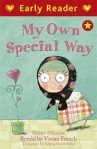
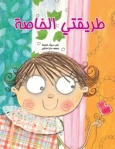 Maithaa AlKhayyat’s ‘طريقتي الخاصة’, translated by Fatima Sharafeddine and Vivian French as My Own Special Way has been named to the very prestigious shortlist of the Marsh Award for Children’s Literature in Translation.
I believe this is the first time a children’s book translated from the Arabic has made the Marsh shortlist; certainly it would be the first Arabic winner.
I haven’t read the English edition, but “طريقتي الخاصة” is charmingly told and illustrated, a young girl’s journey to finding a hijab style that suits her. With a number of absurd attempts at tying the thing on in the way her different older sisters suggest. Humor, big-eyed illustrations, repetition, and a warm family environment make this enjoyable for boys and girls.
My then-8-year-old commented on the book last year: “What I like about this book is all the little details, like the details about how they put on hijab. Like one of the sisters, for instance, is always drinking something, in almost all the pictures, she has a drink with a straw.”
The award is granted every other year, and has gone three times to the great Anthea Bell. The judges this year are Wendy Cooling, Colin Niven, Sian Williams, and Gillian Lathy. They’re scheduled to announce the winner at an awards ceremony on January 23.
The children’s longlist was announced today, along with the longlist for translated titles.

| Book title | Author | Publisher | |
|---|---|---|---|
| 1 | (Arbizi and Grandma Wardah)
Al Arbizi wal Jaddah Wardah |
Muna Al Sharafi | Arab Scientific Publishers, Beirut ,2012 |
| 2 | (A story of an Oyster) Hikayat Mahara |
Flora Majdalawi | Majdalawi Masterpieces, Amman, 2012 |
| 3 | (Jameela’s Eyes) Oyoun Jamilah |
Najla’ Jalal Al Sayyed Allam | Al-Dar al-Masriah al-Lubnaniah, 2012 |
| 4 | (The Warnings of March) Natheer Athar |
Riham Khaled Ba Hussein | Dar Al Thafra, UAE, 2012 |
| 5 | (To whom are the Olives for?) liman Al Zaytoun? |
Fatima Sharafeddine | Dar al-Saqi, Beirut 2012 |
| 6 | Waste Planet (Kawkab Al Nifayat) |
Mikkawi Sa’eed | Zahra’ Al Sharq Library, Beirut 2012 |
| 7 | (Seven Souls) Saba’a Arwah |
Walid Taher | Dar al Shurooq, Cairo 2012 |
| 8 | (Tales of Fannoun) Hikayat Fannoun |
Sahar Abdullah | Elias Modern Publishing, Cairo 2012 |
The North American distributor Syraj.Com is having a big sale. I’m sure this sounds like an advertisement, and I’m sorry for that, but I don’t know of other distributors of Arabic children’s literature and games in North America.
They don’t have all the titles I’d like (I suppose I’d need to make my own store for that!) but some recommendations from my children from the items available at the Syraj store.
Recommended by the 19-month-old
صديقتي الدعسوقة – He must like the glitter, the rhythmic text, and the friendly ladybug. There are three other books in the series, but he hasn’t seen them.
 أصبح كالسمكة – The baby loves all the books in this series, written by celebrated Lebanese author Fatima Sharafeddine, including أشهى لقمة and هيا نم (although let’s not be ridiculous, it doesn’t really make him go to bed). The text is easy to chant and these are among the few bath and cloth books available in Arabic. Cute drawings, too.
Recommended by the 4-year-old
Ahazeej Arabic Nursery Rhymes, books and CD – This is an overlap; recommended by the baby and the 4-year-old. Fun songs and great drawings that reinforce one another. You can see video samples online.
He also recommends the DVD My Arabic Alphabet (PART 1 & 2) (Baby-7yrs) Little Thinking Minds but what he really likes is the CD that we got with it, which he regularly asks to play in the car. As for myself, I don’t need to hear the alphabet song ever again, but he really likes it.
SET of 10: Complete Halazone Series: Jude’s Adventures – Jude gets into situations much like any young child — she procrastinates on her homework, she has a difficult relationship with her younger brother — and although the stories always end positively, there’s no heavy moral and the books are about relating to character.
 بيت للأرنب الصغير – This is a must-have. Repetition, charming animal characters, a little bit of danger, and the child gets to know what’s going on all along. Get the interactive CD, too. Commended by the Anna Lindh Foundation and longlisted for the Etisalat.
ليلى ردي على – About learning to communicate across boundaries. Also commended by Anna Lindh.
Recommended by the 9-year-old
Mostly, he’s into comics at the moment (you know, ميكي and such), but he also wanted to recommend أ ب ت المرحة, a cute flip book that lets kids mix and match parts of animals and various characteristics.
I’m trying out…
 I thought this memory game from Dar al Hadaek might be something all three boys could do together?
And I also admit to buying…
Last week, the Lebanese publishing house Dar al Saqi launched a “Saqi Kids” website.

It seems to be still under construction — at this point, they mostly have listings of their books, separated into “children” and “teens.”
There are still very few websites that have any book teasers or learn-to-read games online. Al Salwa’s lovely website is mostly for parents and teachers, and while you can read the first page of a few books on Kalimat’s website, it’s just a tiny pinch to get you to buy the book. There are the same few books that have been on the Alam Simsim website for a couple years now and a few other reading-oriented games here and there. But no big “learn to read” project that I’ve run across.
It would be great to develop a whole Arabic learn-to-read program online, like Starfall.Com, although I have no idea how they support themselves.
I am being left hopelessly in the dust as I lack an iPad or iPhone, or other device on which to experience digital children’s books:
 I saw the following about Egypt’s Sascha Books:
The company also hopes to bring other publishing houses, like Dar al Shurou [Dar al Shorouk?] and Elias Publishing House in Lebanon, on board, to convert their series of children books, Farhana [by Rania Hussein Amin, I assume!], into interactive books on Sacha Books. They’re primarily targeting the Saudi Arabian market, with the Arabic books, and yet will also offer English and French to reach a broader regional and global market. Read more.
Others with digital/interactive books are, of course, Al Salwa and Al HudHud.
Meanwhile, I am exploring different Arabic curricula for my four-year-old, mostly of the old-fashioned paper variety. But certainly I see the appeal of helping children learn to read with digital and interactive applications.
Thanks to Rupert for sending along the link to this story.
Kel Shahr Kteib (http://www.kelshahrkteib.blogspot.com/) is a new bilingual blog, in Arabic and English, about Arabic children’s literature, written by Susanne Abou Ghaida.
 Abou Ghaida writes: “I also hope that in your own exploration of the world of Arabic children’s book, the reviews in this blog will arouse your curiosity about the books mentioned, that you will read them if you haven’t already done so, and I will have somebody new to talk with.”
It includes both interviews and reviews.
So go on, join!


 Read Kutub KIDS